Showing posts with label Goa - Christianity. Show all posts

Tuesday, December 22, 2009

The Goan Christmas beckons Goa

Its the all too familiar sight in Goa at this time of the year. The streets packed to capacity. Traffic snarls all over the city. The town painted red with with the memorabilia of Christmas. Santa Claus waving from the glimmer of paint from glass fronted shops, Christmas carols renting the air and absolutely no place to park your two wheeler, while your four wheeler has no ambitions to make to the city for a long time to come.

From music shops to food outlets, to cloth shops to gift shops and groceries to Goa Christmasdesigners, from stationers to hair stylists and beauticians  to cold storages and sweet marts, there is a buzz of big time business in Goa for all merchants at this time of the year. With barely 2 days for the Christmas cheer to ring in, there is therefore the last minute scramble to fill up the missing ingredients to ensure that this years Christmas is not compromised for anything.

The prices of eggs normally soar in Goa at this time with a commanding premium. Eggs are major ingredients in many of the Christmas sweets and the Goan Bebinca which is a class favourite among Goans calls for a lot of the egg. Broken eggs or damaged shell eggs do not remain on the shelf and are quickly whipped off by Bebinca makers. These eggs are cheaper compared to normal eggs.

The prices of all essential commodities also become steep as demand rises for various food items. Cashew nuts which is also another major ingredient for many Goan Christmas sweets such as cakes and marzipan, is also in great demand. Demand for Christmas decor always satisfies the passion of most Goans and you will find the streets filled wmarzipan - Goa christmas sweetsith Christmas decor of all types most of which is imported from China and has a lot of takers here. The Goan  Christmas "star" has innovated over the years and the various styles are on display. However nothing can obviously beat the home-made bamboo star which many Goans fondly fabricate till date and the same brings nostalgia to the Goan Christmas.

Goans are also passionate about their clothing and the women always prefer to ring in Christmas while flaunting the crispness of a new dress. Tailors and designers have their hands full all over Goa and you can forget about ordering for a new dress a good 15 days before Christmas and are likely to be turned down. The town is also packed with a host of mens suit shops and from ready-mades to made to order, there is one for everyone.

The cribs at home are being given their finishing touches and the Christmas tree is moving out from the gloom of its storage in the attic to the comfort of the living room with buntings all over. Kids are now expecting good ole Santa to provide them with the gifts that they have been awaiting the whole year .

The curtains are being ironed, and there is a coat of paint given to the peeling walls. The Christmas dance is on the mind and the midnight mass would be the best way to ring in the Christmas cheer for all Goans.

Goa is therefore getting ready for the Christmas flavour, heralding the birth of Christ our saviour and King.

Tuesday, September 15, 2009

Goa's Christian sects upset with Panjim mayors comments

The pleas of various Christian sects seeking space for burial grounds in the city of Panjim which was rejected by the Corporation of the city of Panjim (CCP) last Friday, with its mayor Carolina Po telling the media that the feeling among the corporators was that the people who have converted to other sects should ask those people who led them to convert, to provide burial grounds, came in for scathing criticism from leaders of various Christian sects across Goa.

Some Christian sects such as the Syrian and Methodist Christian sects had reportedly applied  for burial grounds from the CCP which was rejected by the Panjim corporators under the fear that these sects have their numbers scattered all over Goa and granting them a burial ground would therefore result in all their dead being brought from all over Goa, to Panjim to be buried. This was in pursuance of the CCP's resolve under a resolution passed by the CCP last year banning burial of persons not living in the jurisdiction of Panjim city. The cemeteries in the city of Panjim are being run by the Municipal body.

Goa burial ground

However various leaders of different Christian sects from Goa took strong exception to the Mayors comments and termed it undemocratic and a violation of human rights. At a meeting held by the various Christian sects in Margao, the members and pastors of such sects lamented the lack of democracy in the comments and urged people in public positions not to make such strong statements which could lead to a flare-up.

The pastors belonging to New life fellowship church of Panjim, Margao and Vasco, Parakletos Church, Margao, Corner stone church Margao, Mount Zion Church, Good News Church, River of Life Church Panjim, Good Hope Church and Methodist Church were present at the meeting.

A pastor of a River of Life Church Panjim criticised the comments of the mayor saying that there is no question of anybody converting them and that they have chosen to be members of a certain sect out of their own free will and asked the government to look after the interest of all citizens irrespective of their religious backgrounds.

Another pastor pointed out that it is the constitutional right of every citizen to be buried after death and said that burial cannot be denied on any grounds leave alone the religious ground

Saturday, July 25, 2009

NHAI's Satanic ignorance of Goa most deplorable

What is the difference between Saint Anne and Satan? Nothing, seems to be the answer for the National Highways authority of India which has conveniently corrupted the name of Saint Anne with that of Satan on its signboards along the NH 17, which is condemnable to say the least. While one would think that mere sensibilities had to prevail before committing the name SATAN to a peaceful and beautiful village of Goa, it is a mystery whether NHAI decides on the various names of places along the highway on mere hearsay or relies on the advice and diction of its migrant labourers who are engaged in the laying of the roads for its highway.

NHAI signboard in Goa

The village of "Saint Anne" or "SantAnne" in Konkani, is located off the national Highway 17 just before the Pilar junction on the eastern side as one proceeds from Panjim to Margao. A quaint village with peaceful surroundings and an abode of lush greenery, SantAnne is named after "Saint Anne"  and has been in the news recently due to the ambitious renovation plans that have been undertaken of the Sant Anne Church. It is the first village encountered by those who choose to skip the highway enroute to Panjim in quest of a traffic free road which runs through the village and after negotiating some quick twists, turns and hills, takes you through the village of Merces at the other end to reach the city of Panjim. The distance to Panjim through this route is cut down by a good two kilometres.

However it seems that the National Highway authority of India or its people engaged in the listing of names along the highway have allowed their common sense or common knowledge to lie rotten amidst their 9 to 5 duty of completing their assigned tasks of putting up name plates along the highways. Any person worth his school under- matriculation would have the presence of mind to understand that "Satan" is indeed the devil. Common sense would demand of anyone to think twice before listing such an evil name along the highway in place of the actual name and would naturally seek more information through enquiries and be satisfied with a thorough  confirmation of such a devilish name if it ever existed for any place. But not the NHAI. It seems they can do what they wish. Bend turn, melt or mould Goan names of places according to their whims and pleasure.

Village of Sant Anne in Goa

What's more is that the name of Satan has been replaced for the name of Saint Anne, who in her lifetime was known to have worked for the kingdom of God. The disgust stems from the fact  that two extremities, one a Saint and another the devil,  having opposite teachings have been carelessly swapped to misguide people and wound the feelings of Goans and christians in particular.

Another neighbouring village of Batim which has been in the news for apparitions of Our lady, has also been listed as Batti on the same signboard. How does NHAI manage to concoct simple names of Goan villages into disgraceful unrecognisable places is a question the authority needs to answer.

While people in Goa would be willing to forgive NHAI for the umpteen errors in the pollution of Goa's village and city names on Goa's part of NH17, the error of SantAnne to Satan is completely unpardonable and appears to be carried out in complete disregard to the sensibilities of Goans or is the work undertaken by an irresponsible agency either deliberately or by the "chalta hai" wisdom of its ability to be immune to accountability.

By Goacom

Saturday, July 4, 2009

TAG to urge Goa Board to include tiatr in school books

The newly formed Tiatr Academy of Goa (TAG) as a part of its ambitious plan to re-invigorate the essence of the tiatr for Goa and Goans, is set to request the Goa board and the textbook committee to include the tiatr in the school curriculum either as a lesson or as a part of dramatics which is currently being taught as an optional subject in many schools in the state.

According totiatr in Goa the President of TAG, Mr Tomazinho Cardozo, tiatr plays a very important and relevant part in Goan society and is known to have had a major role in mobilising the public at the time of the opinion poll which played the most historic chapter to ensure that Goa remained as a separate state and did not get merged into Maharashtra. Songs and duets from tiatr are also known to strike an emotional chord with people in the state.

Mr Cardozo stressed that besides being a part of Goan culture, tiatr deals with social issues such as drugs and casinos and emphasized that anything that goes against the interest of Goans is brought to the fore by artistes from tiatr and said that students in modern Goa should be made aware about this fact.

Among the other things, to push the cause of tiatr far and wide in Goa and outside, Mr Cardozo lined out a series of activities that the TAG plans to undertake which include organising of seminars and lectures in schools and colleges on the different aspects of tiatr in Goa.

TAG also wants to document the history and experiences of the old tiatr artistes by interviewing them and recording their experiences on films. Tag will endeavour to document the history of tiatr by publishing books on it past legacy.Goa tiatr

Preservation of tiatr literature is also high on the TAG agenda and it has resolved to publish scripts, one act plays and lyrics with the musical scores wherever possible.

A museum is being planned in the state of Goa which will house tiatr material in the form of manuscripts, handwritten lyrics, printed books, old records, CDs, DVDs which may be scattered around the state with government authorities as well as private individuals and collectors and will be exhibited at this museum. this collection of material is expected to begin this year in 2009 and go on uptill the museum is set up.

Tiatr Academy of Goa (TAG) which was set up by the government officially in February 2009 is expecting a funding of Rs 60 lakh towards its various activities. On the anvil is also a plan to encourage tiatr production by youth, technical workshops and seminars to upgrade the quality of tiatrs, promoting the art form as a means of communication outside the state and setting up a website for the academy.

TAG also wants to encourage and revive the use of wind instruments in tiatr and will host Goa tiatrist M Boyera festival of award winning dramas. Artistes of yesteryears will be remembered and honoured through various activities and persons documenting their works will b e provided incentives. A directory of tiatr artistes is also expected very soon. TAG in the meanwhile is also awaiting a premises in Panjim which has already been identified a provision for which is already made by the government which is reportedly to the tune of Rs 1.5 crore.

DSSS for Goans! Domicile comes under scanner.

With the aim of ensuring that only genuine Goans benefit from the Goa governments' much touted Dayanand Social Security Scheme (DSSS) the state administration is mulling to increase the period of stay in the state from a mere 15 years to a more realistic 25 years to prevent migrants from other states from availing the benefit which was actually mooted for Goans.

The suggestion was part of many such suggestions put forth on Goans Friday July 3 2009, when the ad-hoc committee on health and social welfare met for the second time. There members of the committee pointed out to the blatant misuse of the DSSS scheme by pensioners, migrants and by those availing the benefit of other schemes.

The committee was of the view that an immediate survey of thegoans in Goa beneficiaries under DSSS was necessary to weed out undeserving persons to prevent its misuse since the number of claimants for the DSSS benefit was steadily on the rise and the government could find itself unable to sustain the scheme if bonafide Goan people are not verified immediately.

The committee was also critical of misuse of government schemes by producing a caste certificate issued by "samaj' presidents. AlsoGoan people coming under the committees's notice was the rampant private businesses indulged in by employees of government run hospitals at Goa medical college and Hospicio, where such employees were involved in private businesses such as running of canteens, restaurants and money lending which the committee felt should be stopped forthwith.

Tuesday, June 30, 2009

Goa Festivals : Ribandar and Candolim celebrate the Sangodd

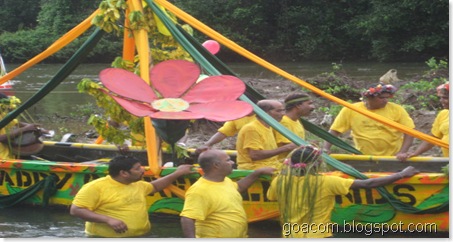
Fishermen in Goa consider June 29th as the sacred day which has been traditionally dedicated to  their patron saint, St Peter. On this day instead of venturing out to catch fish, the fishermen of Ribandar tie three of their traditional wooden canoes  together to form the Sangodd. Palm leaves and other flora are then used to decorate the Sangodd which is made to resemble a chapel.

The Sangodd celebrations in Ribandar commence early morning at 6.30 when the parish priest of the Ribandar Church marches to the beat of the brass band along with a confraria member who clutches to a statue of St Peter and all of them board  the well decorated Sangodd which is waiting for their oncoming. The priest subsequently blesses the village and the river and prays for the fishermen and seeks blessings for their welfare while fishing.

The Sangodd later returns to the jetty and the holy mass is celebrated at the Church. This tradition has been brought down the ages and is over 100 years old wherein the faithful in the village are convinced of the power of the blessings on this day for God to protect them and also provide them with a good catch.

The Sangodd is also celebrated at Orda in far away Candolim which is also another spectacle to watch in the Candolim creek. Sangodd at Orda is known to be celebrated for the last 200 years as most people from Orda were known to be traditional fishermen. Traditionally people from this area were known to keep their daily work routine aside for the day and use their boats to celebrate the feast with a lot of pomp and gaiety.

goa sangoddA chapel of Santa Cruz which is over 130 years old stands by the creek at Orda and the members of the Santa Cruz chapel committee who organise the Sangodd continue with the tradition of erecting a chapel on top of the Sangodd  which was earlier done with bamboos and cloth.

However, nowadays in recent modern times, a neat plywood structure is being erected on the boat instead of a temporary structure. The Holy cross is placed at the topmost point of the chapel and a statue of St Peter is carried out from the holy cross chapel in a ceremony and placed in a small niche just below the cross.

As afternoon sets in, around 2.30 pm an opening hymn is sung by the locals of Orda and subsequently professional singers take over. This year on 29th June 2009, a large number of Konkani artists which included Anil, Olga, Socorro d e Santa cruz, Sonia, Albert, T Britton besides various child artistes and local artistes performed live on board the Sangodd.

Once the gathered crowd is entertained enough, the Sangodd moves to another location to regale another section of the crowds at another point down the creek. After the first point, five more stops are made as the artistes perform much to the excitement and thrill of the large gathered crowds. Slogans such as Viva Sao Pedro can be well heard.

In Salcete, the Sangodd is celebrated at Assolna at round 3 pm along the river sal at three different places. The first point is at the jetty behind the Church, the next one is at Collean Dando at Assolna and the third one is at Ambelim. All of them tie their fishing boats together and erect a stage on board the raft. Various artists sing on these Sangodds which are witnessed by curious crowds along the banks of the river.

Sangodd is therefore a  festival celebrated all over Goa mainly by the fishing community to invoke the blessings of St Peter and to celebrate the spirit of Goa.

Vasco celebrates feast of Sao Pedro in Goa

The feast of Saint Peter or Sao Pedro, the patron saint of the fisherfolk in Goa, termed by many as the "God of the sea" was celebrated by the fishing community at Khariwaddo in Vasco on Monday 29th June 2009 as per their annual tradition. Prayers seeking better prospects in the coming fishing season were offered on the occasion.

The feast of "Sao Pedro" is an annual affair  for the fishing community residing in Vasco's areas of Khariwaddo, Non-mon, Pixem-Dongri and other areas inhabited by the community who engage in fishing activities in the port city. This is a traditional feast celebrated by these communities and dates back to centuries when their ancestors began the tradition.

This time around, after offering prayers at the Old Cross chapel at Khariwaddo, by the parish priest of St Andrew's Church Vasco,  Fr Jose Antonio Da Costa, the members of the fishing community went towards the Khariwaddo jetty in a procession to the accompaniment of the brass band. Next they embarked into the sea in colorfully decorated fishing canoes which were adorned with flowers, leaves, balloons and coconut palms.

Here the parish priest offered prayers to Sao Pedro and also sought a blessing for the fishing community and prayed for God's protection on them when they venture out into the high seas to earn their bread.

The celebrations culminated with all the fishing community groups such as the Ramponkars, the Magkars, the Boatkars and other members of the community offering prayers and then venturing into the sea in their decorated boats.

Thursday, June 25, 2009

The Goan Sao Joao Song

Here's the famous Goan Sao Joao song which lends the extra fervour to the Sao Joao Spirit in Goa. From the north to the south of Goa, the Sao Joao song is sung with a lot of love and emotion by Goans. The lyrics of the  song are a wonderful combination narrating the nostalgia an old rustic Goan village camaraderie which is melodious to the ears and the tune tends to reverberate the senses long after the song is sung and over with.

Sao Joao fest  

                   SAO JOAO CANTAR

Sogle ami zanvoim vortotaum, chodda tempan bhetleaum
Sao joao-chem festh mhunnon ami manvoddea aileaum
Mateak him kopelam ghalun uddok navonk bhair sorleaum
Aichea dissak voddle ami nokom khuim pauleaum.


Chorus
Sao Joao, Sao Joao gunvta mure vatt amkam dissona
Aicho dis urbecho konn konnak hansona
Choll-re pie-re tum illo ghe-re faleam kaim mevona
Oslim festam vorsak kiteak don pauti enam.


Zanvoim ami festak aileaum mun ganvan bobau poddla
Mhojea sasupain tin kouxe soro addla
Tin kudvanchim sandnam keleant ani dhukor marla
Sezarchea konsu manan ponos daddla.

Chorus
Sao Joao, Sao Joao gunvta mure vatt amkam dissona
Aicho dis urbecho konn konnak hansona
Choll-re pie-re tum illo ghe-re faleam kaim mevona
Oslim festam vorsak kiteak don pauti enam.

Vhooddilanchea kaiddea pormonem uddok nataum bhaimchem
Khoddegant fest hem amchem manvoddechem
Pondra diss alchenoi hangache bhorench ami ghevchem
Choll atam sao joao vhoria maguir tem pouchem.

Chorus
Sao Joao, Sao Joao gunvta mure vatt amkam dissona
Aicho dis urbecho konn konnak hansona
Choll-re pie-re tum illo ghe-re faleam kaim mevona
Oslim festam vorsak kiteak don pauti enam.

Viva Sao Joao

Tuesday, June 23, 2009

Sao Joao celebrations beckon Goa

The feast of Saint John the Baptist is a favourite among Goans and the entire state gets set at this time of the year to get its watery act together to celebrate what is commonly known as "Sao Joao" festival in Goa. In Salcete, the feast is celebrated with a lot of gusto especially in the village of Benaulim which has the Church of St John the Baptist and the feast is on the 24th Of June. Sao Joao Day!

The Church of St John the Baptist in Benaulim is located on the  picturesque hillock situated at the entrance of Colva and towards  Benaulim. This Church also has a unique architecture and is well admired by tourists whsao joao revelry in Goao flock to the place when they visit Colva and Benaulim. Novenas are held for 9 days prior to the feast day and the feast is celebrated with a lot of pomp and gaiety known to be part of such feasts in Goa. This time as usual there are a lot of programmes lined up including singing and dancing acts besides the prospect of watching a tantalising soccer match. Besides the  Benaulim parish, the feast is also celebrated in other villages of Goa such as Cortalim, Harmal and Terekhol in the north.

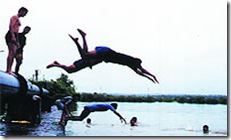
An unique tradition which runs is that the son-in-law gets invited to the brides house on the feast day. Also the newly married son-in-law wears a crown of fruits or leaves and jumps into the well. It is believed that it is for this very reason that many youngsters  jump in wells all over Goa in celebration and revelry accompanied by the sounds of the ghumot and traditional music and songs such as some delightfully sung mando's. Rivers, ponds, lakes and pools are not spared for a bountiful dip on this day asao Joao - jumping in wells in goand the young and the old join in the melee which reaches a crescendo towards the afternoon. Goan food, traditional drinks and various Goan delicacies make their way into this festive mood and the whole atmosphere is of fun and joy.

The chant of "Viva Sao Joao" is however not limited to south Goa alone and the north of Goa in fact has various locations where the celebrations are far more wider and louder. It is believed that St John the Baptist leapt with Joy in his mother Elizabeth's womb when she was visited by mother Mary. This is actually the basic background under which the "jumping" in the wells has become a traditional feature in Goa. Villages of Anjuna, Calangute Vagator,  and Siolim celebrate the feast of Sao Joao in a pompous manner.

In the village of Siolim, the celebration is very prominent and every village area plays its part with places such as Igrejavaddo, Gaunsavaddo, Marna and Fernandesvaddo chanting the "Viva Sao Joao ' in style. Distribution of Jackfruit, mangoes , Goan foods and pouring of water on newly married daughters-in-laws is a tradition in Gaunsawaddo.

In Siolim and in Goa as a whole the spectacle to look out for during  the Sao Joao celebrations is however the grand boat parade which has increased its followers over the years. A large number of people flock to witness this parade and this 175 year old history sao joao celebrationsof celebrating Sao Joao in this village continues till date. However the event which may have started long ago on a small note has magnified in size and shape to turn out into a major attraction of Goa. The youth are traditionally known to merge from the neighboring places around Siolim coming in decorated boats wearing crowns or tender coconut leaves, singing Mandos and playing the Ghumot. After reaching near the cross in front of the church,they light candles at the cross, put a garland, light firecrackers , perform the "Saude" and dance around with the chant of Viva Sao Joao.

The boat procession is a replication of the entry of the Portuguese merchants along with the miraculous statue of St Anthony. The event was given a more organised shape in the year 1992 by some traditionally live Goans from Siolim and thus the "Sao Joao traditional boat parade" was formally christened. Later a committee was formed and since 1997 the Siolim Sao Joao traditional boat festival committee ensured that the festival was organised in a proper manner till date.

Sunday, May 31, 2009

Goa's "Purumentachem Fest" at Margao today

One of the major Church feasts in Goa associated with the stocking of provisions for the monsoon season is the feast of the Holy Spirit at the Holy Spirit Church Margao, which is also fondly known all over the state as the "Purumentachem Fest" of Goa.

While there may be many such feasts close to the monsoon season, it is believed that this feast at Margao essentially derived the reputation of being Margao Holy spirit feast the original  "Purumentachem fest" owing to its closest proximity with the monsoon season in Goa.

"Purumentachem Fest" a konkani term, could easily be translated into "Feast of Provisions " is a time for people to stock provisions for the monsoons. Although the feast has nothing to do with provisions, the timing of the feast induces a large gravitational pull over the crowds who flock to the fair at this feast to net a good bargain against all kinds of vendors displaying their goods, wares, stocks and harvests. Therefore many items and provisions that do not find their way at other feast fairs in Goa can be spotted at this fair. This peculiarity of certain items being sold only at this May month feast at Margao enticed people visiting the fairs to buy stocks in larger quantities by keeping in mind the upcoming Monsoons. That factor is probably the reason why this feast has derived the strongest bond with the term " Purumentachem Fest"

Salted Fish at the fair in Margao is considered to be the best bargain and people from far and wide within Goa and outside make a special trip to Margao for the feast to help themselves to stock up various varieties of salted fish. Kite fish ( solvve) is a distinct favourite amongGoa salted fish salt fish shoppers at this market as they are considered the most ideal for a good fish pickle (parra) and would help to pull off with the best meal on a rainy day. Dried prawns are almost a must and can help in making some delicious curry. Also the Bombay ducks in salted form known as the "Sukhe Bombil" have always been considered as a quick appetizer if roasted against the fire. Therefore this feast helps to keep the dying traditions of making nostalgic pickles such as "parra", 'balchao" and "molho" distinctly alive in Goa.

Besides the salted fish there is also a sale of traditional harvests of distinct Goan onions and other vegetables which can be stocked for the season. There is the usual fair of the wooden furniture where the traditional carpenters from South Goa display their wares be it beds,sofa sets, tables, benches, stools, showcases , cupboards etc etc. The furniture is known to give the sellers a ready easy market to display and sell their goods while also sourcing new customers for their future supplies.

The Grinding stones such as the flat grinding stone as well as the traditional "Rogddo" are also in full flow at the feast and while one goan rogddo may think that the electric mixers have taken over the Goan homes, the enthusiasm of these grinding stone traders to market their goods, belies that theory. There seems to be still a distinct lobby in Goa which is wedded to the apparent difference in taste, rendered with the use of the grinding stones and "rogddos' in their day to day requirements for cooking various curries, masalas and sweets in Goa.

Earthen pots are still ruling the roost in rural as well as urban Goa and the testimony to the fact is the regular return of these breed of traders who faithfully ensure that they occupy a portion of the market square at this Margao feast to show off their traditional wares  which need no introductions.The "Kunnem",the "burkulo" the "gurgulet" and the gardening vases get automatic buyers at this festival owing to their traditional attachment and the utility that  these earthen wares still command from the "niz goenkar" (true goan) more out of emotional attachment and traditional love than the practical compulsion to use them.

Then there are the other wares such as copper and aluminium vessels, garden tools such as pick axes, choppers, hammers etc. There is also a distinct readymade clothesline on display although most of the clothes at such fairs are of poor quality there is always the enthusiasm of the fair which unquestionably propels the visitors to  make frantic buys. Bedsheets and tablecloths besides other cushion materials are also on display and command sizeable crowds in the evenings.

Finally, one cannot miss the "kaddio-boddio", "laddoos"  "revddios" and the random open stalls of "festache chonne" ( Grams of the feast) which can be easily spottkadio bodioed all over the fair with the avid "festakar"  ( feast shopper) ensuring that he/she has atleast one pottli of the "kaddio-boddio" and one or two "poll" of the "festache chonne".  Without these sweets finding their way into Goan homes, people often consider their visit to the fair as an incomplete one and therefore the traders of these eatables are traditionally known to make brisk business by urging the people to buy some sweets in memory of the feast of the Holy Spirit.

Monday, April 27, 2009

Goa's Milagres Saibinn feast at Mapusa

For the many things that Mapusa is famous for, one of them is certainly the Milagres Feast which draws huge crowds to the city of Mapusa in North Goa. Mapusa's feast of Our lady of Miracles draws peMilagres saibin, milagres feast Mapusaople from all religions and communities besides the Catholics from Goa. In Goa the tradition of devotion to mother Mary exists profoundly and people of other communities often make a point to attend the catholic feasts of our Lady.

For the Catholics who celebrate this feast, Mother Mary is the Milagres Saibinn while for the non-Christian Goans, Milagres Saibinn is "Tulzai Sateri Devi".

Prior to the feast , a nine day novena is observed and the feast is celebrated on the second Monday after Easter Sunday and is scheduled for the 27th April this year. Somehow it has a special connection to the Shirgao zatra that usually follows the feast.

At Shirgao, it is Goddess lahirai that is worshipped and according to tradition, Lahirai and Milagres Saibinn are considered sisters. According to a very prominent publication from Goa, Goan folklore traces the lady of Miracles of Mapusa to be one of seven sisters who was converted to the catholic religion by the Portuguese. Her other six sisters are apparently worshipped at different temples in the state of Goa. Ketko is known to be the only brother who is revered by the fishing community in Chopdem in Goa.

So come 27th may, the religious divide if there is any in Goa, simply dissolves while a flock of Goans make their way to Mapusa on Monday to seek the blessings of Milagres Saibinn.

While Catholics believe in the intercessory powers of Our Lady in eternal salvation, the Hindus consider her as the incarnation of Goddess Mirabai, sister of Goddess lahirai. During the feast, Catholics offer garlands of the firecracker flower or Ratan Abolim and candles or wax replicas of body parts while Hindus also do the same while also doing an Abhishek of the statue with coconut oil.

While the Mapusa Church is dedicated and named as the Church of St Jerome, it is more popularly known as Milagres Church as it is the most popular feast of the Mapusa parish and is therefore celebrated with much pomp and gaiety while also being considered as the feast for the traditional purchase of provisions and grinding stones as per the well known Goan tradition of "Purumentachem fest" just as is done in Margao for the feast of the Holy Spirit.

There is also the interesting traditional exchange between the two supposed sisters. While lahirai sends one 'colso' ( pot) of oil on the feast day, Milagres Saibin reciprocates by sending a basket of mogrim( fragrant flowers)  on the zatra day.

Milagres saibinn is also considered as a deity who cures ailments and the sick come to her seeking her intervention.Meanwhile the temple of Shree Lairai Sateri at Shirgao which is located around 2 kms from Assonora on the Panaji-Valpoi Highway will come alive with its Sirigao or "firewalkers' zatra on April 29th.

Goa parties vs Goa elections

Goa parties in this case are not the political ones that are fighting the Goa elections. Rather they are the ones who have been crying foul that elections are responsible for their party going awry. Wedding party that is.

It is no secret that over the years, the various directives of the election commission seem to have infused a discord among common men and many of the directives seem to be out of touch with reality and the prevailing customs and traditions or ground realities of a particular region or state.

The latest controversy over banning of liquor at wedding parties in Goa has been met with a very bitter taste from the affected party people who have termed this high-handed autocratic attitude of the election commission as being out of sync with common sensibilities. Such an attitude only contributes to the frustration and irritation of the common man in Goa who is more inclined to boycott voting thereby undermining the whole electoral process.

Weddings in GoaIt has to be noted that wedding parties in Goa are planned months in advance, if not years. During such planning, most often,  neither the elections are decided nor the government announcements to that effect is made. No notifications are done while Goans are busily preparing for that great day in the life of a family. With elections suddenly beating the drum, are Goan weddings expected to shut down their plans at the last minute at the cost of all the planning and with much money down the barrel?

The custom of serving liquor at weddings is a traditional Goan custom as also being an Indian custom at many Indian weddings all over the country. However it is more prominent in Goa since colonial times. Such wedding receptions in Goa are private affairs with no public access to such parties. how does such conduct affect the elections in Goa? That too despite seeking specific permission on a case to case basis? Isn't the denial of permission to such wedding receptions a case of extreme high handedness by the concerned authorities?

It seems that the election commission is keeping Goa on par with states with a rampant history of poll violence such as lawless Bihar or belligerent UP, in absolute disregard for Goa's history and cultural traditions besides being the country's hottest destination of world tourism.

Inducing the closure of over thousands of bars and wholesale liquor shops etc in the name of elections for weeks together does not improve the conduct of elections in any way. All that it causes is artificial shortage to the common man which is abused by black marketers as per their whims besides the inconvenience to Goans , hardships, monetary loss and loss of business for Goa thereby straining the government exchequer due to an inexplicable clampdown.

It is therefore time for the election commission to do some self-introspection and identify the areas where its stubbornness is causing more harm than good. Whether its efforts in a particular direction bear the fruit for which they were instituted or whether the enforcement of certain directives only contribute towards the bitterness of the common man without riddling the actual problem.

All rules and regulations need to be updated regularly keeping in mind the practical situations at hand while ensuring no dilution in the effect caused towards seeking the desired results.

Wednesday, April 22, 2009

Goa University to team up with Instituto camoes

Goa university's Portuguese department and Instituto Camoes are together slated to organise  a series of activities to commemorate the 35th anniversary of April 25th 1974's Carnation Revolution also known in Portuguese as the"Revolucao dos Cravos".

It may be recalled that the military coup of that date which had its leanings towards the Left, began on April 25, 1974 in Lisbon, Portugal and heralded the change of regime in Portugal from a dictatorship to a democracy after a two year transitional period.

As a part of the activities, on April 24th, a talk will be held on the topic " Portugal throbbing with a new heart' by a former senior lecturer of St Xavier's college and author of many books, Mr Vasco Pinho.

Silvia Braganca, a Goan born artist and teacher at the ENAV( Escola Nacional das Ates Visuais) maputo Mocambique and researcher of Art education, will speak on " 25th of April 1974- Portugal and the overseas people's freedom". There will also be a documentary ' As Duas Faces da Guerra ( the two faces of the war) a film on colonial war in Africa produced by Diana Andringa and Flora Gomes which will be screened at 7 in the evening.

On the 25th of April a talk will be held on ' I missed the revolution of Cravos of April 25 1974 by a whisker... But I can depose on its trial and repercussions' by a well known lawyer Mr Fernando colaco, who will speak about his experiences before the outbreak of happenings in Lisbon.

This is expected to be followed by the "Carnation revolution in Goa and East Timor" by department of Sociology, professor at the Goa University Dr Alito Sequeira who will speak on social changes which took place after the revolution.

A documentary ' Nos e os Outros- uma Sociedade Plural' ( We and the Others- a Pluralistic society) will be screened at 7 pm and on April 26 some films produced in Portugal in the last 30 years will be screened.

Os Lisboetas 9 20040 by Sergio Trefaut , a documentary about the emigration wave which changed Portugal in the last years will also be screened at 11 am. "Portugal SA" ( 20040 by Ruy Guerra,  a political thriller exposing the dark side of the politicians and their ties with the corporate world will be screened at 3 pm

A Sombra dos Abutres ( 1998), the maiden venture of Leonel Vieira has a plot set in Tras-os-montes, the North eastern region of Portugal, in 1961, when Portugal was under a dictatorship and was controlled by PIDE ( a police force serving the regime and which oppressed all those who were against it) will be screened at 5 pm. "O cinema Portugues  depois do 25 de Abril de 1974" by Serge Abramovic will also be screened.

Goa Wedding plans hit hard due to dry election spell

The weddings in Goa which were planned much more in advance to the schedule drawn up by the election commission had to face the weddings in Goaunreasonable brunt of dry days with the commission refusing to grant permission to couples getting married in Goa to serve liquor for the ensuing celebrations.

The excise authorities which received 14 applications from all over Goa from couples with impending wedding celebrations slated for the 21st and 22nd of April had to face the denial by the excise authorities  as the election commission turned down their proposal to grant temporary licences to serve liquor to guests at the reception venues of the wedding celebrations.

Couples tying the knot were therefore a disappointed lot, after the election commission rejected their proposal to authorise the Goa government to issue temporary licences to couples planning wedding celebrations.

However it has to be noted that these couples had planned timagehe weddings at least a year or more in advance to the election commissions declaration of election dates and therefore it was a hard pill to swallow for all the couples who had petitioned the government to grant permission. Tuesday saw nine weddings in the state of Goa with six of them in Salcete , two in Bardez and one in Taleigao.

Meanwhile a number of people gathered in front of the office of the Chief electoral officer on Tuesday morning to register their protest against a comment made by an official that the affected wedding parties could cancel their weddings or postpone it to a later date if they were feeling troubled by the restrictions. Citizens complained that the weddings were planned a year in advance and such comments were uncalled for.

Meanwhile after declining the permissions there were raids conducted on many wedding venues in Goa and the wedding parties were advised to refrain from serving liquor at all costs.

Wednesday, April 15, 2009

Sea bathing soothes people in Goa every summer

Come March-April every year, Goans head for the beaches. The summer seems to be a wake up call for Goans reminding them that there exists a beach which is calling. For the rest of the year, Goans are lost in their busy schedules and do not even think about the beach too often like the rest of the world does. But if its summer, it has to be Goa's beaches.

The healing powers of the beach waters have been part of traditional folklore for Goans who sincerely believe that the waters of the ocean offer the much needed relief in the scorching heat of the summer while inducing the healing touch to a variety of ailments.  

So it is a common sight to watch Goans submerged waist deep in the waters of the beach for hours in the testing heat, with their brown skins gleamingGoan sea bath as if they were soaking up a tan. On the contrary, this is a typical Goan practice of a rejuvenating sea bath in the summer.

Some Goans believe that this kind of a soaking bath has its effects only in the summer and not during other seasons in the year. So as the summer picks up itself, Goan families get together  along with neighbouring friends and relatives to spend at least a day or two on the sand, soaking in the ocean before winding back home towards dusk time.

Across the state of Goa it is a familiar sight to see residents near the beach especially around the beaches of Colva, Benaulim, Calangute, Baga, Arambol and Miramar where there is a sudden rush flocking for an energising bath. So from the inner villages, towns, nooks and corners of Goa the doddering Goan oldies, grannies, mothers and toddlers all come for their traditional date with the sea, equipped with towels, lunches and tasty snacks for a bath with all the comforts at hand.

Many Goans swear by the waters of the sea claiming that the body remains fighting fit for the rest of the year with an annual bath. Some others opine that a sea bath is not only refreshing during summer time but also keeps away pains and aches from bones and keeps the skin disease free.

There are other Goans who believe that a sea bath for a couple of days can ward off degenerative ailments like arthritis and keep swelling of joints and bones at bay. In fact bathing in the sea in Goa during the months of March, April and May is a faithful ritual that envelopes all communities and classes.

There is a strong belief that a dip in the summer is more helpful due to the high salinity believed to be in the sea water and the duration of the soak is considered very important. The older generation feels that a person needs a dip in the sea at least thrice a day with no cleansing with fresh water for  a period of 24 hours after bathing to get maximum benefit

Sunday, April 12, 2009

Goa celebrates Easter!

Goa joins the rest of the world in celebrating Easter, the joy of the The risen Christrisen Christ.The whole state of Goa witnessed midnight masses signalling the rise of the eternal King from death after three days as promised in the holy scriptures.

Easter is indeed the sacred celebration of the resurrection of Christ from the dead and is the oldest and holiest Christian festival the climax and centre of the liturgical year and the holy day to which all other holy days point. The Easter day comes on Sunday which is two days after the Good Friday and is celebrated with tremendous joy and thanksgiving in Goa.

For Christians the foundation of the Christian faith is the life, death and resurrection of Jesus Christ. Christ lived the righteous and perfect life that we, because of our fallen and corrupt nature, are not able to live.He suffered the penalty for our sins by taking our guilt upon Himself and dying a horrible death on the cross. He rose bodily from the dead that first Easter morning ensuring that we who have  been baptised into his death and resurrection will rise again in glorified bodies on the last day. This is the great pascal mystery that Christians have celebrated since the earliest days of the Church.

In many parts of Goa as also the rest of the world, the Easter egg has become synonymous with this day. The story about the Easter egg is that many ancient cultures ago eggs were a common Goa Easter eggssymbol of new life and immortality. In olden times, Christians adapted the egg to their own religious devotions by abstaining from eating eggs during lent and resuming it after Easter. Eggs came to represent the Lord's resurrection -- just as Christ broke out of the tomb on Easter morning, the yolk of the egg breaks out of its shell when cracked. The decoration of eggs for Easter is a part of the folk traditions of many cultures, although it has no religious significance.

Friday, April 10, 2009

Good Friday observed today in Goa

Its a day of fast and abstinence for lakhs of catholics in Goa and the rest of Good friday - crucifixion of Christthe country today as the world observes Good Friday, commemorating the crucifixion of Jesus Christ on the cross and his death at Calvary.

While Good Friday marks the death of Christ, it is not a day for mourning as many may be believed to think. On the contrary it is a day of triumph in tragedy. It is a day to be born again by letting our old selves die and begin a new birth. It is a rising in dying to ourselves and our bad behaviors.

The period of Lent which began on ash Wednesday lasting for 40 days of penance and abstinence ends with the day of Easter when Jesus Christ rises again on the third day. Good Friday is therefore basically a reflection on the sufferings and death  of Jesus Christ.

On the occasion of Good Friday, the prayer service is held only in the parish churches and begins late in the afternoon and is constituted of three parts. Namely the Liturgy of the word _ where the word of God is spoken. The Veneration of the cross and The Holy communion.

In the first part, there are the two readings from the Old testament followed by the Gospel reading of St John often sung in the churches with different priests or lay people singing out the different narrations of the Bible reading. In the second part of the service, the crucifix which is kept covered with a blue cloth is unveiled in parts with intermittent prayers after each unveiling part of the crucifix. Finally in the last part of the service is the Holy communion which is distributed among the faithful.

In Goa the service finally ends with the purple curtain which covers the view behind the altar being drawn apart to enable a full view of a life-size statue of Jesus Christ nailed to the cross. Some parishioners dressed in traditional Jewish costumes climb the ladders to the top of the cross and lower the statue of Christ after unfastening it and then place it in a casket . This is a Portuguese custom followed in Goa. The congregation then moves in an orderly procession with the members of the confraternity taking up the casket on their shoulders.

In the Se Cathedral at Old Goa there is the traditional 'xempddeanchem pursanv" today, which is a unique ceremony , a procession of tails called as 'capas magnas" in Portuguese. This practice  is believed to have started after the cathedral chapter was established on February 4 1557. for the occasion, there is a solemnity maintained and instead of cheerful bells the procession starts to the rattling of wooden clappers which were used in ancient times.

Sunday, April 5, 2009

Goa observes Palm Sunday!

The holy season of Lent is about to come to an end and it is the last palm-sunday remembrance week in the 40 day period of penance. The period ends with the day of Easter which is preceded by religious rituals such as Palm Sunday followed by Maundy Thursday and Good Friday.

Palm Sunday is a symbolic remembrance of the day palm sunday in Goawhen Jesus entered the city of Jerusalem just before Passover, the Jews waved the palm branches to welcome him. Goa observed Palm Sunday today when the priest representing Jesus is followed into the Church by people with palm fronds. Earlier people are given  the palm fronds when they come to the Church and some even weave the fronds into decorative crosses.

Later in the week, the faithful observe Maundy Thursday when they symbolically recreate the last supper of Jesus and 12 men are chosen to be his disciples. During the mass, the priest removes his vestment, ties a white cloth around his waist  and bends down to wash and clean the feet of the 12 men.

Tuesday, March 31, 2009

History of Goa Velha's "Santachem Pursanv"

The Santachem Pursanv is one of the two traditional processions still alive in Goa. In olden times Goa used to see many religious processions conducted by the various religious orders existing in Old Goa.However due to various reasons many of the processions did not survive.

The processions included the "Corpus Christi' procession which was held on the first Thursday after Low Sunday,the procession of the Rosary by the Dominican fathers, the procession of the flagellants, and that of the " bones of the Hanges" by the Confraternity of Charity

In passing times of Goa, most of these processions were either banned or simply died out in the last couple of centuries. However the ritual practices of Lenten tableaus which were practiced in olden Goa, are still continued with fervour till this day.

Goa Velha Santachem pursao

The two processions that still continue till this day are the procession of the "Capas Magna" at the Se Cathedral in Old Goa which is most commonly known in Goa as the "Xeppdeanchem Pursanv" on Good Friday and the procession of the "Santachem Pursanv" held at Goa Velha on the Monday after Passion Sunday ( 5th Sunday of Lent) . Goa is the only other place besides Rome to have these processionsas of date.

The objective of the "Procession of Saints was to inculcate a sense of spirit of prayer and penance into the hearts and minds of the faithful, taking the saints as  role models who actually were simple people belonging to this world and who devoted their lives to Christ and thereby sanctified themselves.

This penitential  procession of the Franciscan third order, had originally 65 images of saints in their original life sizes and vestments which originally used to leave the Pilar convent Church and pass through neighbouring villages and return to the convent with people from different walks of life , the rich and the poor being present for the event.

However in 1835 there was a change of guard as Queen Maria II of Portugal issued a decree abolishing religious orders in Portugal and its colonies due to to which there  was a stop to the procession in an interval when nothing happened  and many images and vestments were destroyed.

Interestingly until 1935, the procession was traditionally held on Monday of the first week of Lent.However with the new church when the procession came to Goa Velha and since then is being held on the Monday following the passion Sunday.

In the years 1889 and 1895, there were new images added . Santa Angela Monica was offered by the villagers living in Bombay. However the original number of 65 was never restored and on todays date only 30 saints are part of the procession. They are, St Francis of Assisi, Pope Innocent III, St. Michael, Cardinal St. Boaventura, St. Clare of Assisi, St Francis of Assisi with St Lucy and St Dona Bona, St Pascal Bailan, St Rose of Viterbo, St Roque, St Isabel, Isabel of Hungary, St Antonio of Lisboa,Cardinal St Peter Pdamiao, St Bernardo, St. Louis IX King of France, St. Filipe, St Ina of Assiz, St Roa of Lima, St Francis of Assissi and St Domnic, Immaculate Franciscan, Ecce Homo, the Divine Nazarene, the martyr of Golgota or the man of sorrows embracing St Francis of Assisi, St John Evangelist, St Mary Magdalen, St Angela Marcia, St Francis of Assisi.

The lead tableau has a cross with two hands crucified, one representing Jesus and the other St Francis of Assisi and they form the arms and symbol of the Franciscan order. the final tableau is one depicting St Francis of Assisi on his knees seeing a vision of Christ being crucified and on the hands, feet and the chest, the wounds of Jesus Christ are visible.

Goa witnesses traditional "Procession of saints"

Goa Velha a beautiful village near Pilar, sprang to life yesterday, just like it does every year this day, as it was the day for the Christian tradition known as the "Procession of Saints" or better in Konkani, "Santachem Pursanv".

This event is part of the lenten season in Goa observed by catholics with consideration to the liturgical practices followed by the Church and which have come down through the centuries after having been introduced by the Portuguese in Goa.Santachem Pursanv

The "Santachem pursanv" is an event which is held on the fifth Monday of Lent and draws people from the neighborhoods as well as from many pats of Goa and begins in the evening with mass in the compound of St Andrew's Church Goa Velha.

Before the mass is held, Catholics make their way inside the Church and kiss and venerate the statues kept inside while whispering their prayers and wishes as they touch the feet of the statues. Subsequently the mass begins at around 4 pm and just before the sun goes down, the life sized images of saints dressed in different vestments and mounted on tableaus are seen emerging from the Church to mark the beginning of the "Santachem pursanv".

There is a particular order followed as the tableaus are carried by four Confraria members dressed in distinguishable ceremonial robes which are known as the Opa_Murca. The first tableau consists of the Tau and the crossed Arms, which is the logo of the Franciscans and depicts one arm each of Jesus and one of St Francis of Assisi while the last tableau has St Francis of Assisi receiving the stigmata on Mount Alverna. 

Procession of saints

After moving the statues out of the Church, the tableau pauses at the podium where a brief narration of the life of the saint is read out in konkani. The tableau bearers along with the people and the devotees then proceed along the traditional route with each of the thirty tableaus following the procession.

There is also a peculiar ritual followed by devotees during the procession. Devotees stand in queue and duck under each tableau in the belief that this act is capable of absolving them of sin and also grants them the blessings of the saints. The procession finally winds up with with each tableau being kept at a particular place inside the church square.

The priest then preaches his sermon and subsequently the images are carried back into the Church where they are kept for three days for veneration. This marks the beginning of a pompous fair with various food items, toys, clothes and other such articles occupying the outside area.

In the Olden days it was a tradition to travel on foot or by bullock carts to be a part of the "Santachem Pursanv" and the pilgrims used to find a place to rest anywhere in the village.

Blog Widget by LinkWithin